Kaely Monahan
Arts & Culture Journalist
diverCity Co-Founder & Co-Executive Producer
CBS News Editorial Intern
Everything Theatre Reviewer

“Sensibility was central to daily Georgian life. It inspired a huge increase in public entertainments.”-Moira Goff
Photo courtesy of Creative Commons
Georgian Britain reveals who we are and why
What does it mean to be British? If the new Georgians Revealed exhibit at the British Library is any thing to go by, then it is all about culture.
The exhibit, like the Georgian era, lavishly depicts life during the 18th and 19th centuries. It takes viewers on an extravagant tour where they will learn where “British-ness” came from.
“The Georgians made us who we are,” says Moira Goff, curator of Georgians Revealed.
But is this true?
Ernestina Taleb, who teaches English to foreigners agrees. She says that when she thinks of "English-ness" she sees “the proper English gentleman; usually with a monocle and moustache.”
“And of course tea!” She added.
She was not the only one to see the correlation between the past and present. Lupita Flores, 27, from America said that Britain was and is a fashionable place. But she also says that often there is the stereotype that Britain is a very proper place as well.
She said:
“They do everything by the book."
Clearly, the Georgians left a deep impression on contemporary British society.
The majority of the stereotypes about England are due largely to the Georgian era.
Many of the iconic and most admired buildings in London were built during this period. The grand neo-classical architecture of the Bank of England; Regent’s Street and Park; the museums and libraries; they all are Georgian.
Goff said:
“The architecture we love all came from them.”
And it is not only physical monuments that remain. They quite obviously left their mark on the many behaviours and habits that are seen as quintessentially British.
Lupita Flores said:
“I always think of them as drinking tea all day.”
New ideas about philosophy, fashion, and taste along with polite social etiquette started with the Georgians.
Their thirst for entertainment was nearly insatiable. All things fine and beautiful were sought after. An explosion of operas, plays, and ballet filled the many theatres. But the Georgians, like us, were also curious about the foreign, strange and even weird.
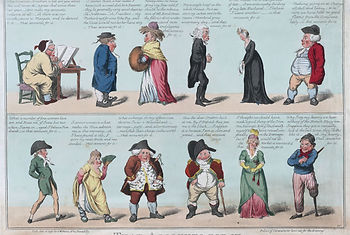
Tricks and illusions, the bizarre and grotesque, all of this attracted the crowds. This was the era where the modern circus got its start.
Moira Goff further explained that:
“All of this fed a new celebrity culture.”
A print by Issac Cruikshank depicting various Georgian stereotypes. (1799)
Photo courtesy of Creative Commons.
Much of our society shares this appetite to be entertained. The only difference is that the venues have changed, if just a little.
Instead of sideshows and circuses, we have Ripley’s Believe It Or Not! and Circ du Soleil. Venture off the beaten path and modern Londoners can find the strange and wacky just like their Georgian ancestors.


Horse shows were just as popular in 1808 as they are today. Right: Astley’s Amphitheatre, London. Left: A modern circus. Cavalia Odysséo show.
Photos courtesies Creative Commons and Cavalia
“Fashion became essential,” Goff says.
A culture of vanity began, and every proper Georgian kept up with the trends, and if possible stayed a little ahead.
This is not so very different our fashion savvy society of today. It can be argued that the first modern fashion craze began with the Georgians. Both ladies' and gentlemen’s magazines were filled with the latest and hottest trends.


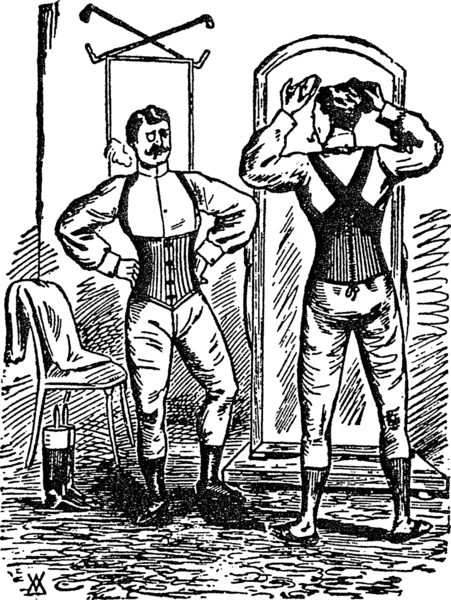
Our own fashion magazines are not too different from the Georgian’s.
Top Right: Lady's fashion magazine; Top Left: Advertisement for men's corsets.
Photos all courtesy of Creative Commons
So did the Georgians leave as strong of a mark as Moira Goff claims? It appears so. Just remember, next time you have a cup of tea be sure to tip your hat to the Georgians. They made it a social necessity after all.
First published on 8 November 2013